Kana: everything a beginner needs to know about hiragana and katakana
Japanese is written in three scripts at once. Two of them spell sound and are finite — forty-six characters each, learnable in a fortnight. The third runs into the thousands, and every one of its characters is read in the first two. That is why kana is not a stage you pass through: it is the notation the whole language is written down in.
The three scripts, and what each one does
Every Japanese sentence mixes all three. They are not alternatives; they do different jobs.
There is a fourth thing you will meet, rōmaji — Japanese written in Latin letters. It is a scaffold, not a script. It is useful for exactly one job: telling you what a new character sounds like. After that it keeps your eyes translating instead of reading, so the sooner it goes, the sooner kana becomes automatic.
Hiragana vs katakana: same sounds, different jobs
This is the question almost every beginner asks, and the answer is simpler than it looks. Both scripts spell exactly the same 46 sounds. か and カ are both ka. What differs is when each one is used, and what they look like.
- Shape. Hiragana is rounded and flowing; katakana is angular and built from short straight strokes.
- Use. Hiragana writes native Japanese words and all grammar. Katakana writes loanwords, foreign names, sound effects and emphasis.
- Difficulty. Hiragana has more curves to draw; katakana has more characters that look alike. They are hard in different places.
- Order. Learn hiragana first, then start katakana as soon as hiragana is comfortable — not months later.
Both share the same structure too. Voiced forms are made by adding two small strokes; a small circle on the H row makes a p; a small ゃゅょ glues two characters into one beat; a small っ holds a silent beat. Learn each rule once and it applies to both scripts.
A study order that finishes the chart
The most common failure is not difficulty, it is drift: learners get most of the way through hiragana, never quite start katakana, and lose both over a quiet fortnight. A sequence with a defined end fixes that.
- Week one — hiragana, in rows. Five characters a day, learned as rows rather than alphabetically. Read each row out of order before moving on.
- Week two — hiragana by hand, plus voiced forms. Write each row from memory, then add the dakuten and combination tables, which are marks on shapes you already know.
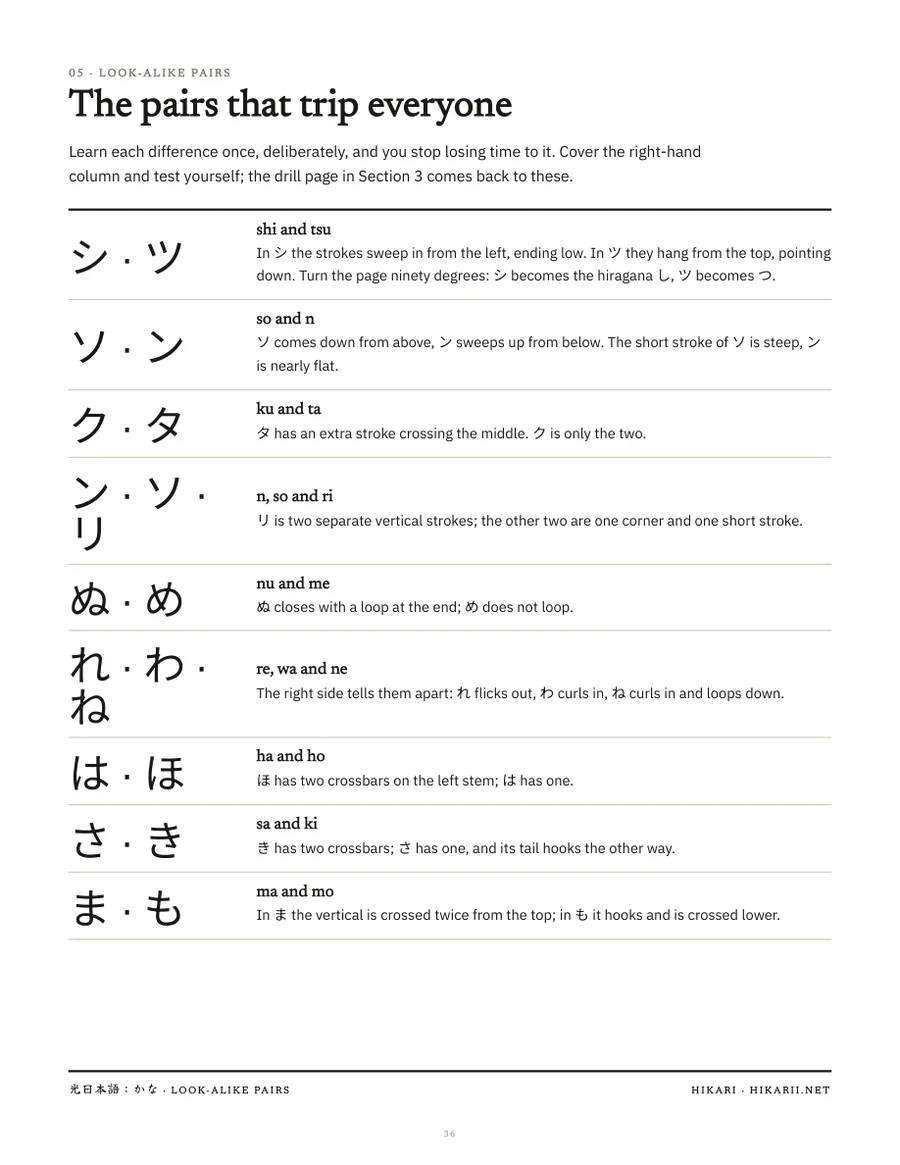
- Week three — katakana, in rows. Faster than hiragana because the sounds are already yours. Slow down on シ/ツ and ソ/ン.
- Week four — reading, no romaji. Real words in both scripts. This is the step that converts recognition into something that survives a break.
Two rules run through all four weeks. Test out of order, always — reading a chart top to bottom teaches you the sequence, not the characters. And write by hand: recognition and recall are different skills, and a pen trains both.
The mistakes that cost beginners the most time
- Staying on romaji. It feels faster for a week and costs you a month.
- Treating katakana as optional. It is the script on the menu in front of you.
- Only ever reading the chart in order. Shuffle it or you have memorised a song.
- Skipping stroke order. It is what makes fast handwriting legible and look-alikes distinguishable.
- Ignoring small characters. A small っ or ゃ changes the word — きって and きて are not the same thing.
- Dropping long vowels. こと and こうと are different words, and ビル is a building while ビール is a beer.
What a finished kana study path looks like
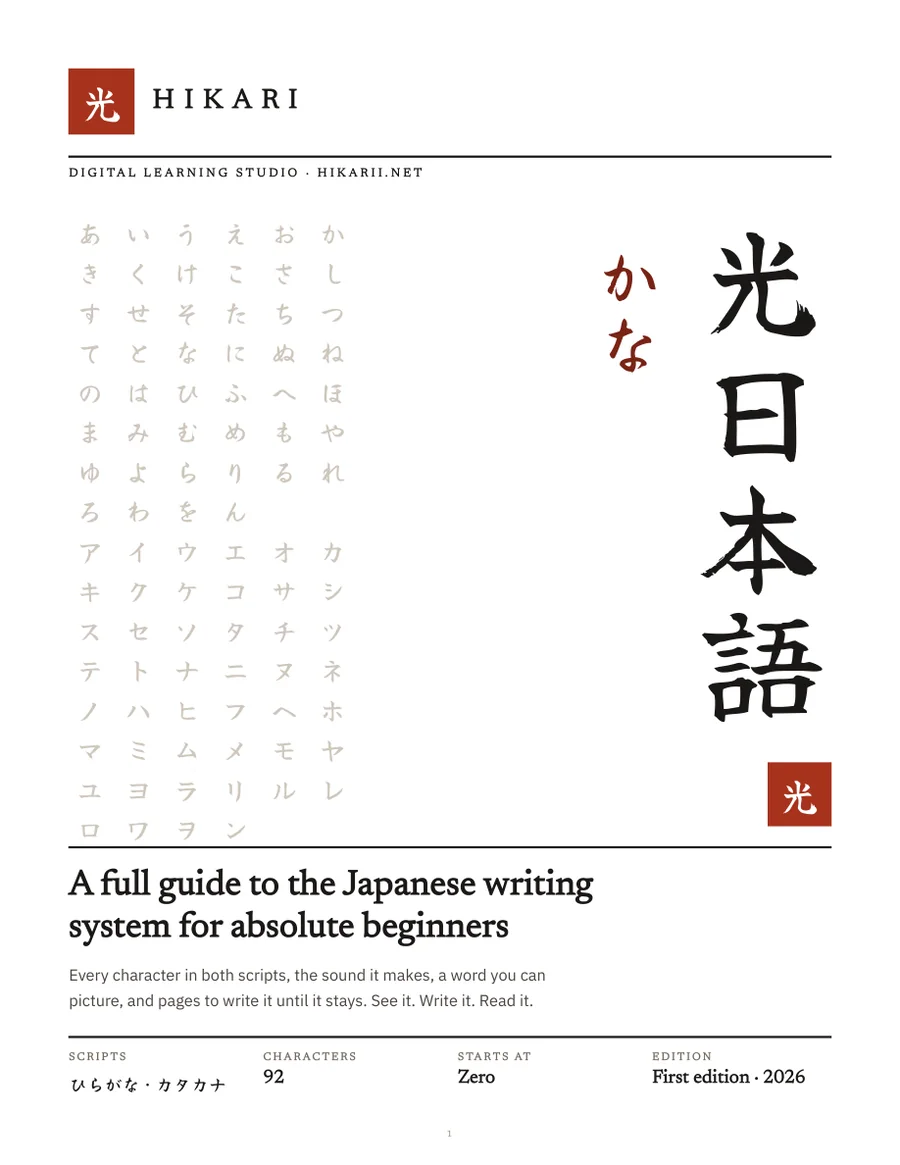
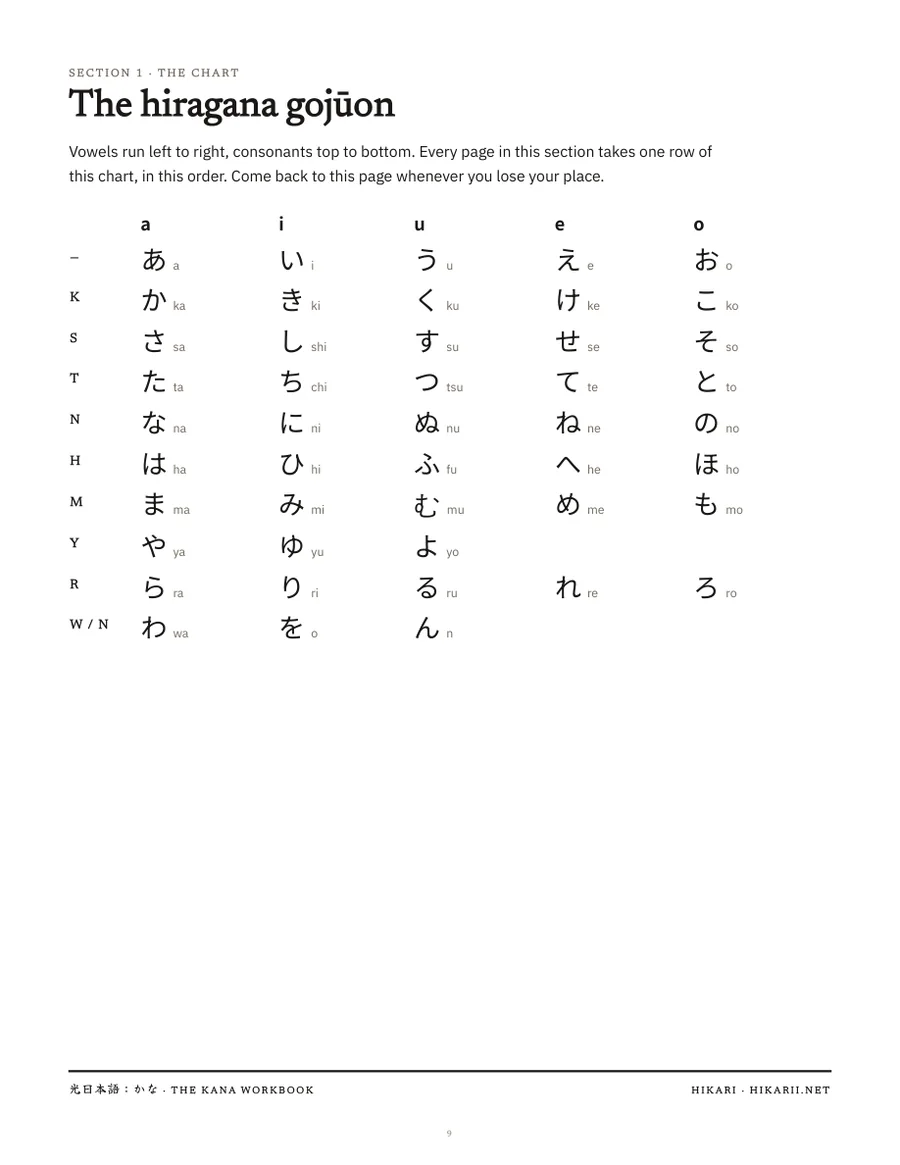
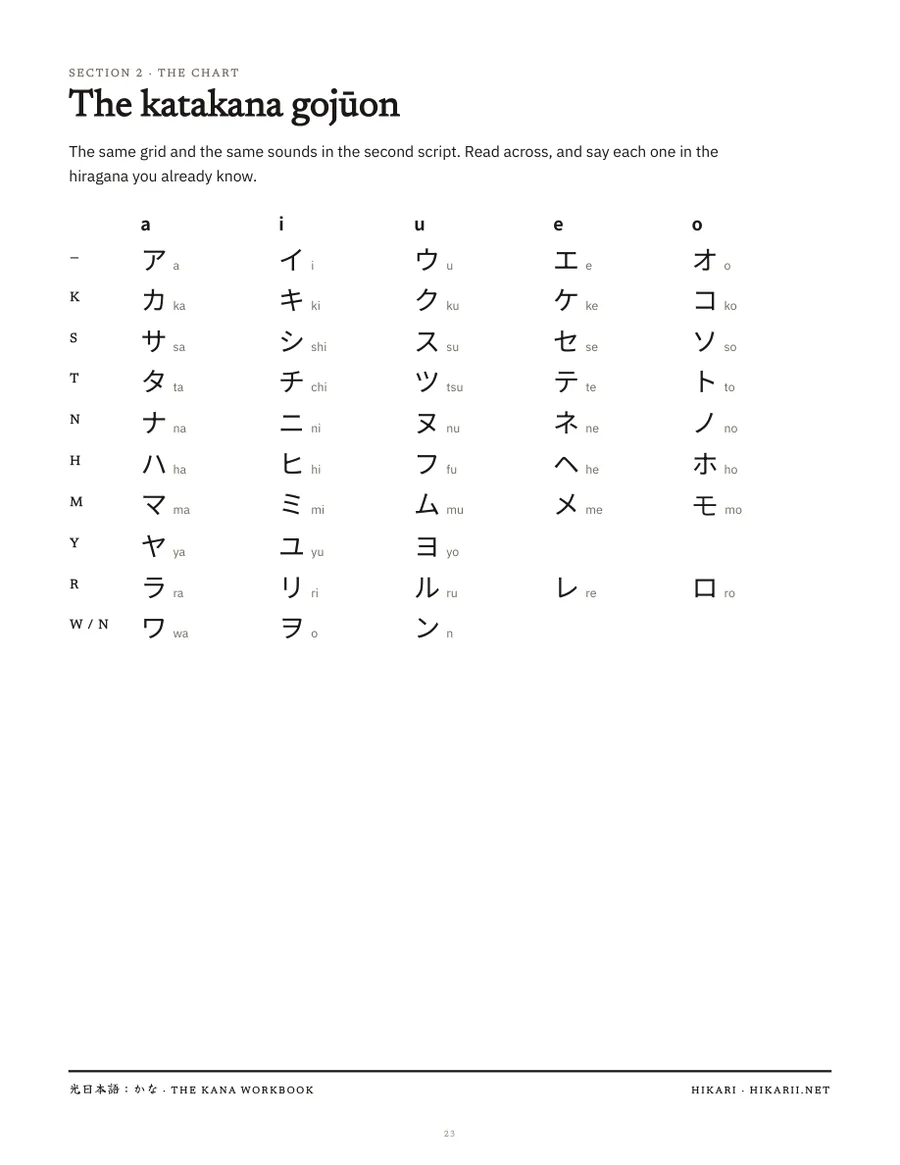
Real pages from the Hikari Kana Workbook: both charts, the look-alike pairs untangled, tracing and handwriting practice, reading drills with no romaji, and a tracker so you can see the chart close.
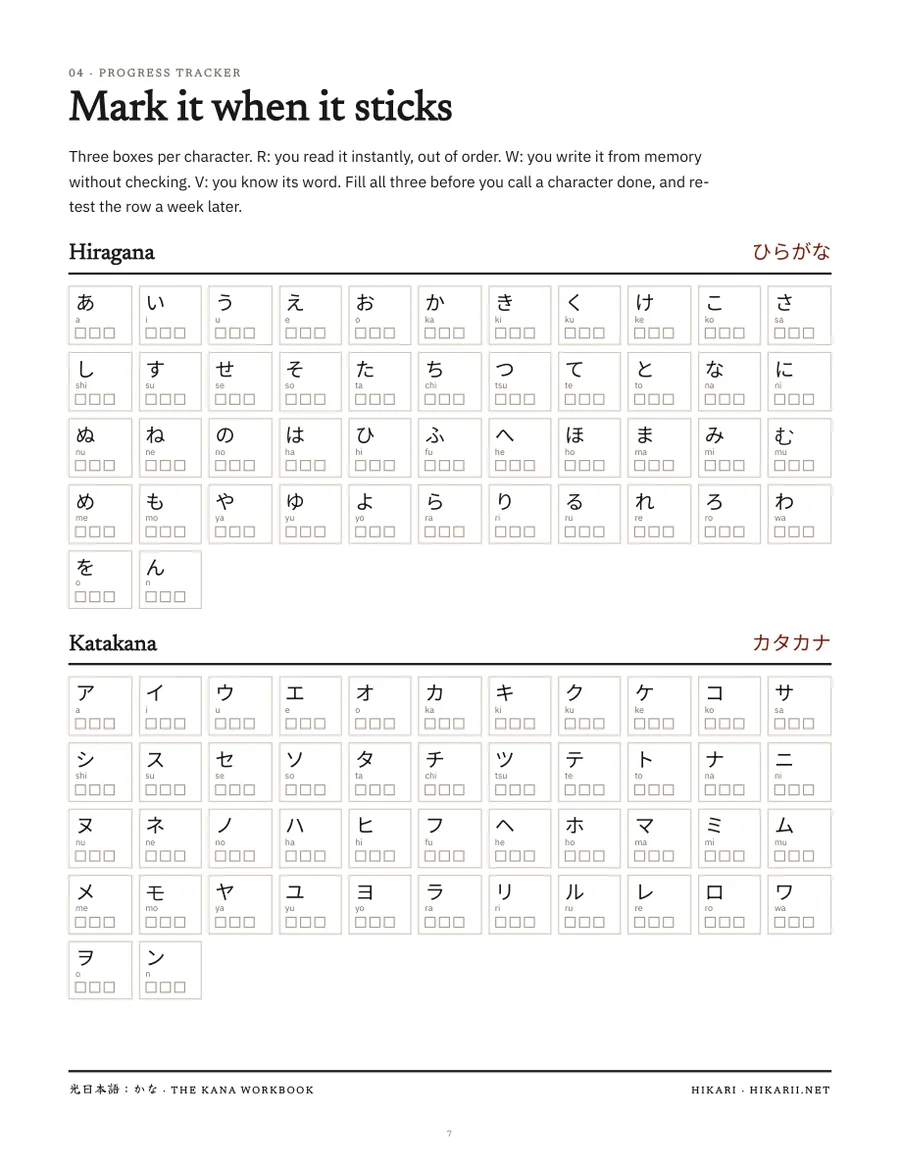
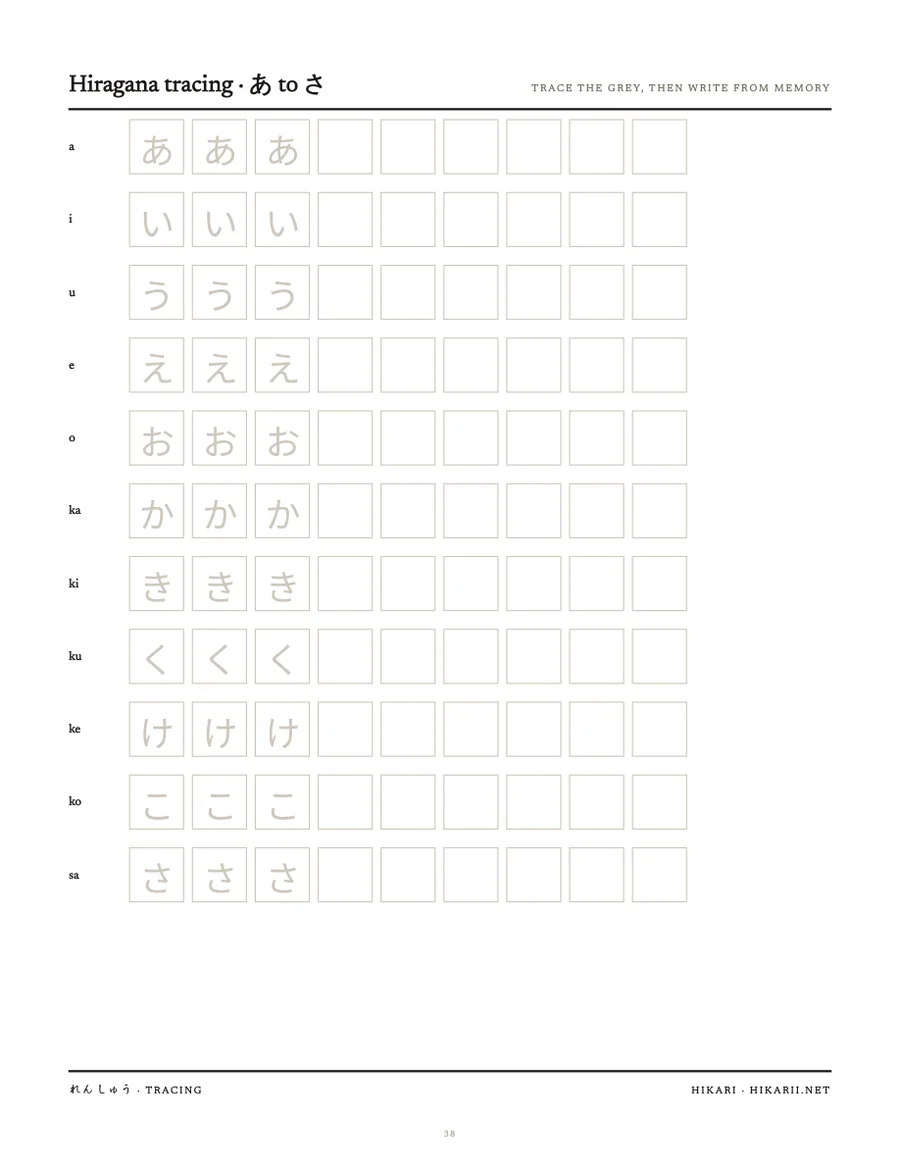
Get the free Kana Starter Pack
Fifteen characters, real tracing pages, a mini reading quiz and a progress tracker. Enough to finish your first row properly and find out whether this way of studying suits you.
Common questions about kana
What does “kana” mean?
Do I need to learn kana before kanji?
How long does it take to learn both scripts?
Should I use romaji while I learn?
Is there a difference between kana and kanji?
What comes after kana?
Where to go next
Hikari Nihongo: Kana
All 92 characters across both scripts. Every voiced form, every combination, every look-alike pair untangled. Stroke order, tracing pages, handwriting grids, reading drills with no romaji, and a full answer key.