HIRAGANA · ひらがな
Hiragana: the complete chart, and how to actually learn it
Forty-six characters that spell every sound in the Japanese language. Hiragana carries the grammar — every ending, every particle, every function word — so no Japanese sentence can be read without it. It is also the shortest, most finite thing you will ever learn in this language.
46 CHARACTERS25 VOICED FORMS33 COMBINATIONS1–2 WEEKS
The hiragana chart
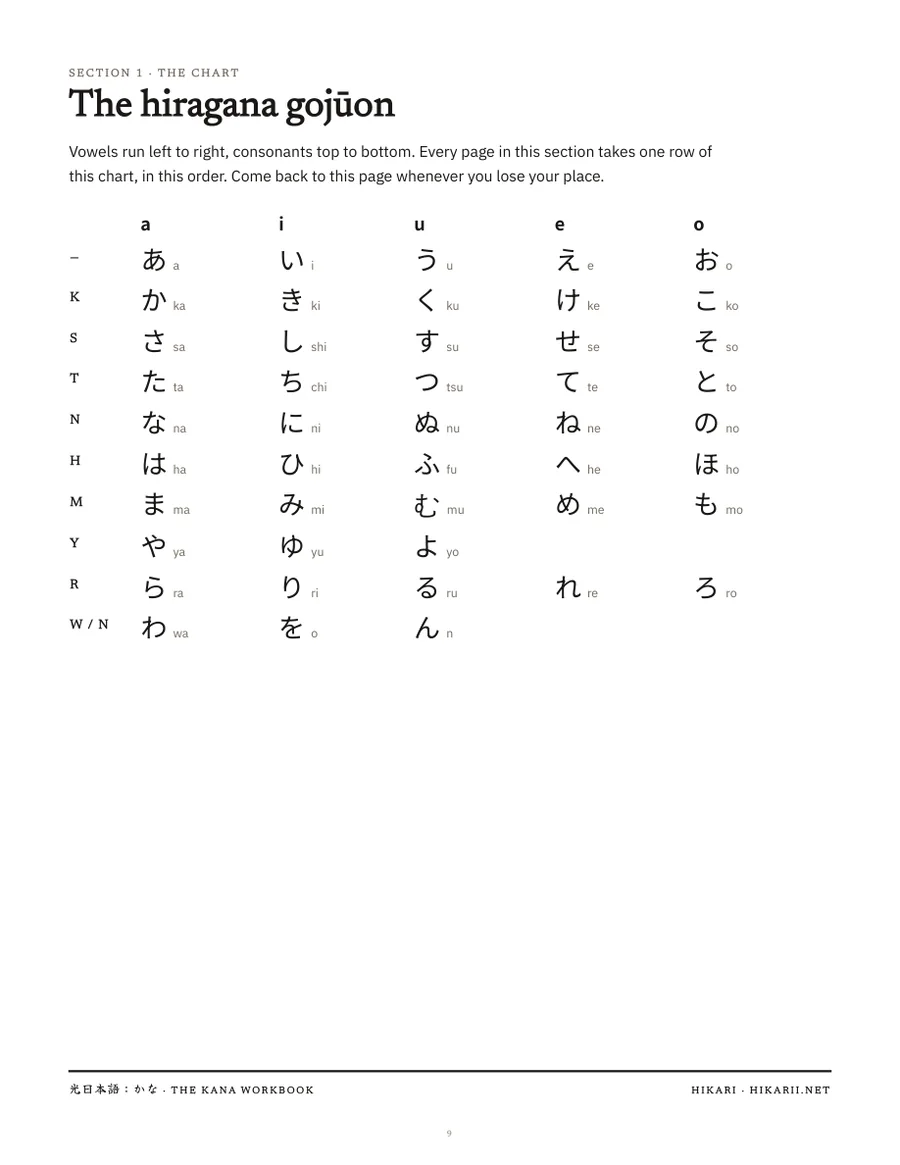
The grid below is the gojūon, the order Japanese itself is indexed in. Five vowels run across; consonants run down. Read it as a system rather than a list: か is k + a, き is k + i, and so on all the way down. Learn the five vowels properly and most of the chart becomes arithmetic.
あa
いi
うu
えe
おo
かka
きki
くku
けke
こko
さsa
しshi
すsu
せse
そso
たta
ちchi
つtsu
てte
とto
なna
にni
ぬnu
ねne
のno
はha
ひhi
ふfu
へhe
ほho
まma
みmi
むmu
めme
もmo
やya
ゆyu
よyo
らra
りri
るru
れre
ろro
わwa
をwo
んn
The 46 basic hiragana in gojūon order. Gaps are sounds that no longer exist in modern Japanese.
Two characters behave differently from the rest. を is pronounced o and is only ever used as a grammatical particle, never inside a word. ん is the only kana that is a consonant on its own, and it borrows its sound from whatever follows it — n before t and d, m before p and b, ng before k and g. You do not have to decide which; your mouth does it for you.
Start with the five vowels
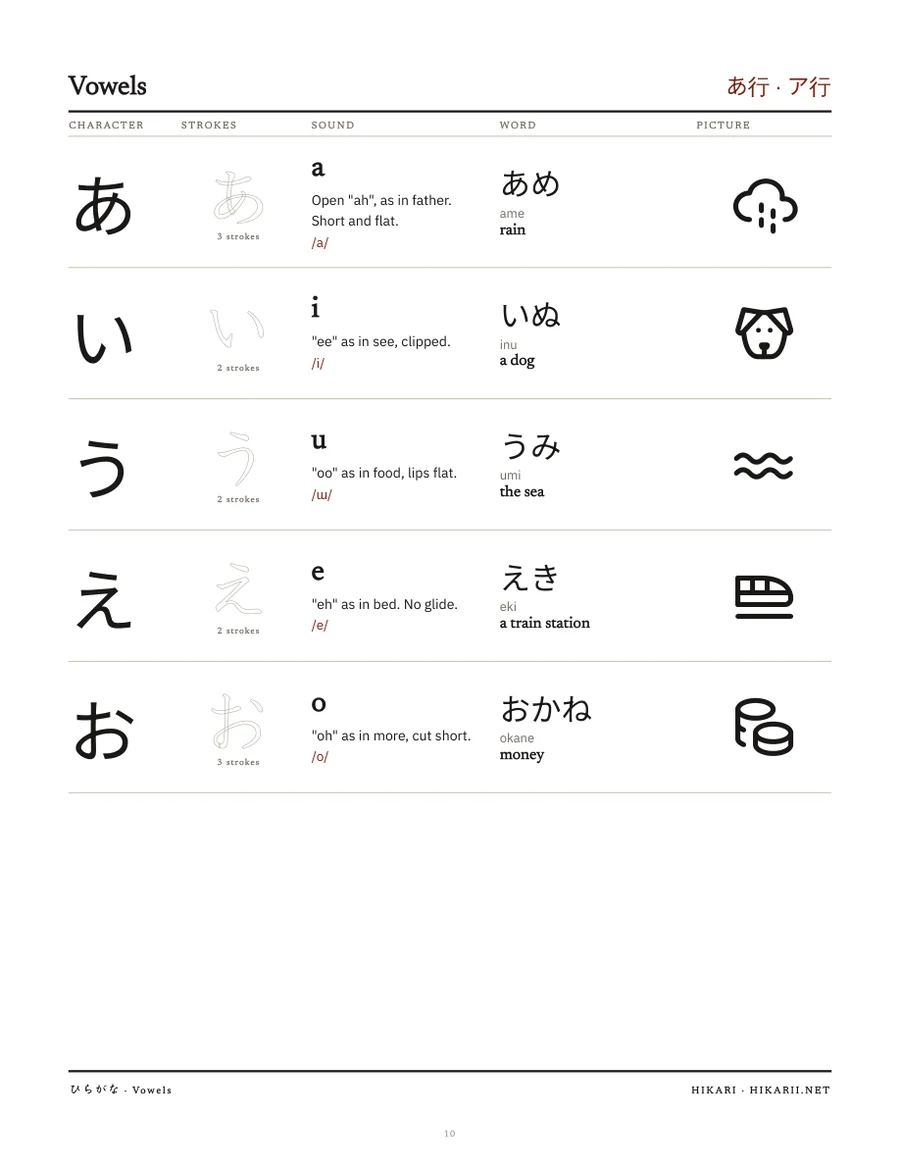
Almost every kana is one consonant plus one of five vowels, so these five sounds do most of the work in the language. Keep each one short and flat — Japanese does not glide from one vowel into another the way English does.
- あ a — an open “ah”, as in father. Never the a of cat.
- い i — “ee” as in see, clipped short.
- う u — “oo” as in food, but with the lips flat rather than rounded.
- え e — “eh” as in bed. It does not glide into a y sound.
- お o — “oh” as in more, cut off before the w.
One more habit worth building on day one: every kana is one beat, and every beat is the same length. か-さ is two even beats, not a stressed one and a weak one. English stress is the hardest habit to drop and the fastest thing to fix.
Voiced forms: two small marks, twenty new sounds
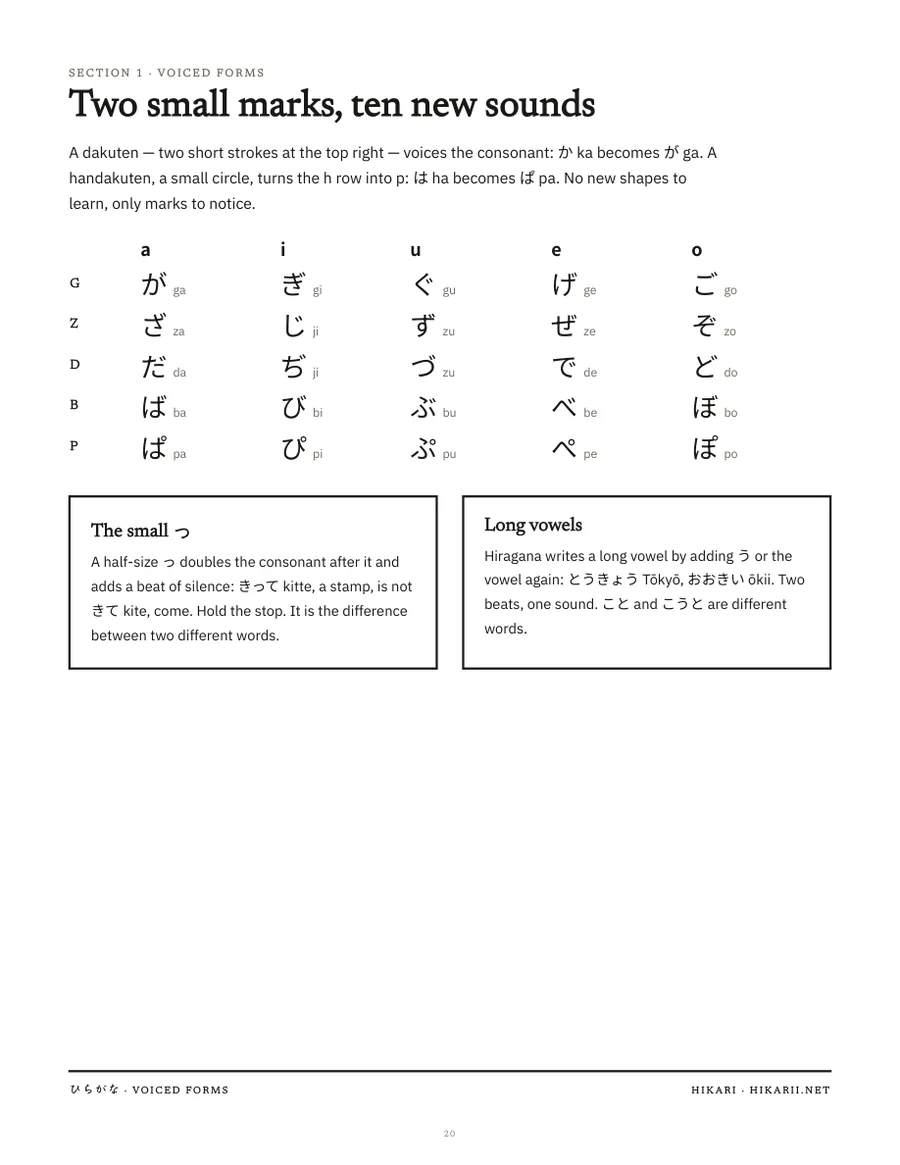
A dakuten — two short strokes at the top right — voices the consonant. A handakuten, a small circle, appears only on the H row and only ever makes a p. Nothing here is a new shape to memorise; each one is a mark on a character you already know.
がga
ぎgi
ぐgu
げge
ごgo
ざza
じji
ずzu
ぜze
ぞzo
だda
ぢji
づzu
でde
どdo
ばba
びbi
ぶbu
べbe
ぼbo
ぱpa
ぴpi
ぷpu
ぺpe
ぽpo
Read the table aloud in pairs — か ka, が ga; は ha, ば ba, ぱ pa — and the difference stops needing thought within a day.
Combinations: two kana, one beat
A small ゃ, ゅ or ょ after an i-column character glues the two into a single syllable. き ki plus small ゃ is きゃ kya — one beat. Written full size, きや is two beats and a different word, so the size of the character carries the whole meaning.
きゃkya
きゅkyu
きょkyo
しゃsha
しゅshu
しょsho
ちゃcha
ちゅchu
ちょcho
にゃnya
にゅnyu
にょnyo
ひゃhya
ひゅhyu
ひょhyo
みゃmya
みゅmyu
みょmyo
りゃrya
りゅryu
りょryo
ぎゃgya
ぎゅgyu
ぎょgyo
じゃja
じゅju
じょjo
びゃbya
びゅbyu
びょbyo
ぴゃpya
ぴゅpyu
ぴょpyo
The other small character worth knowing now is っ. It makes no sound at all: it holds one silent beat and doubles the consonant that follows. きって is kitte, a stamp. Drop the pause and you have said きて, kite, which means “come”.
The hiragana that look alike
A handful of pairs cause most of the hesitation beginners feel, and they are worth learning as pairs, deliberately, once. Learn the difference and you stop losing time to it every time you read.
ぬ · め
nu and me
ぬ closes with a loop at the end. め does not loop.
Loop at the tail means ぬ.
れ · わ · ね
re, wa and ne
The right side tells them apart: れ flicks out, わ curls in, ね curls in and loops down.
Only ね ends in a loop, so eliminate that one first.
は · ほ
ha and ho
ほ has two crossbars on the left stem. は has one.
Count the bars on the upright.
さ · き
sa and ki
き has two crossbars. さ has one, and its tail hooks the other way.
Two bars is き. One bar is さ.
ま · も
ma and mo
In ま the vertical is crossed twice from the top. In も it hooks and is crossed lower.
Crossings near the top means ま.
The katakana look-alikes are worse — シ and ツ in particular — and they are covered on the katakana page.
The order to learn them in
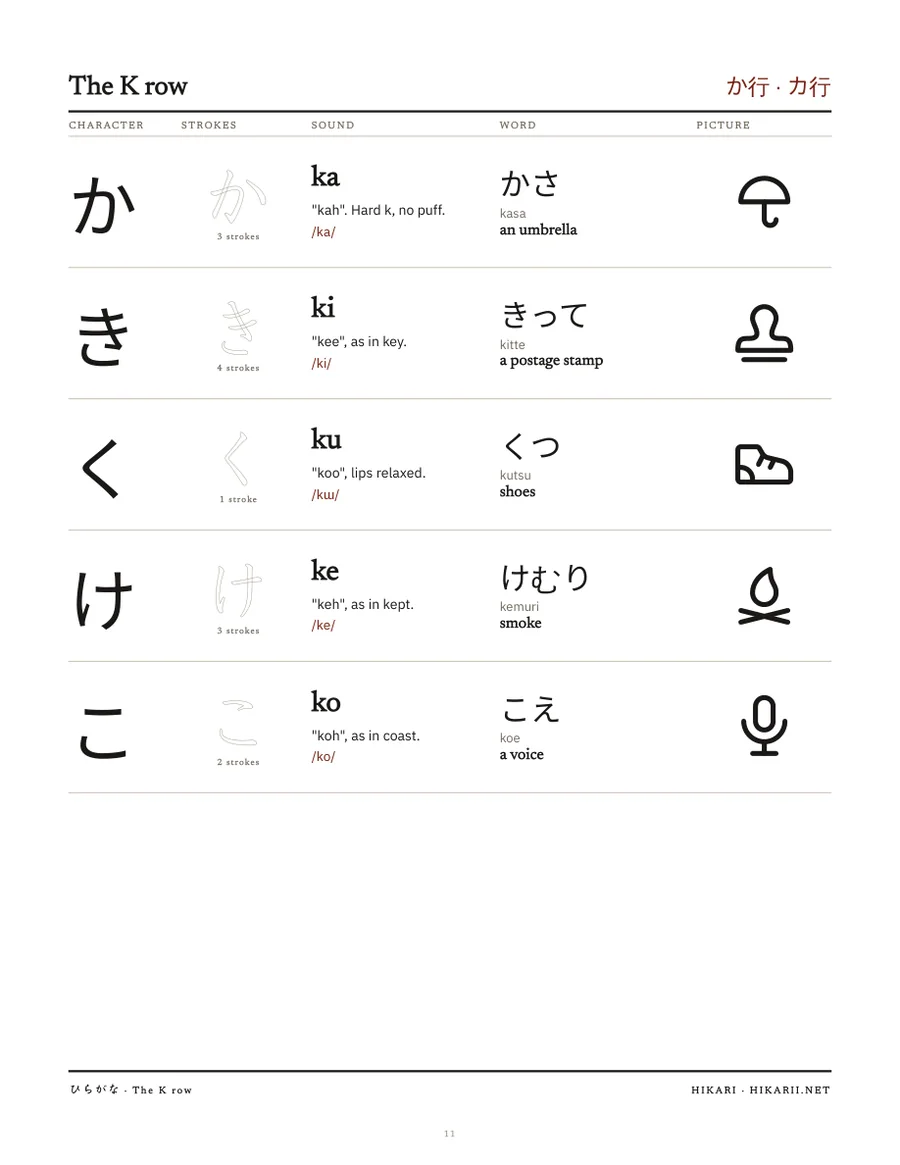
Learn hiragana in rows, not alphabetically. Each row is one consonant run through the same five vowels, so かきくけこ is one pattern rather than five unrelated shapes. It is also the order every Japanese dictionary, index and menu is sorted in, so the sequence pays you back later.
- Vowels あいうえお — the foundation of everything else.
- K and S rows かきくけこ さしすせそ — watch し, a single stroke that curves the other way.
- T and N rows たちつてと なにぬねの — note that ち is chi and つ is tsu, not ti and tu.
- H and M rows はひふへほ まみむめも — ふ is somewhere between f and h.
- Y, R and W やゆよ らりるれろ わを — the R row is closer to a light Spanish r than an English one.
- ん, then the voiced forms and combinations — by this point they are marks on shapes you know.
Test yourself out of order from the very first row. Reading a chart top to bottom teaches you the sequence, not the characters. Cover the romaji, read the row backwards, and whatever makes you hesitate is what you practise tomorrow.
Read real words as early as you can
Recognition becomes permanent when it happens inside a real word rather than on a flashcard. These are all written in hiragana alone, so you can read every one of them with the chart above. Try each before you look at the reading.
やま
yama
a mountain
ねこ
neko
a cat
みず
mizu
water
さかな
sakana
a fish
ともだち
tomodachi
a friend
がっこう
gakkō
a school
せんせい
sensei
a teacher
でんわ
denwa
a telephone
Notice what the harder ones are teaching you: がっこう has a silent held beat and a long vowel; じてんしゃ ends in a contracted sound. Those two features account for most early misreadings.
FROM THE WORKBOOK
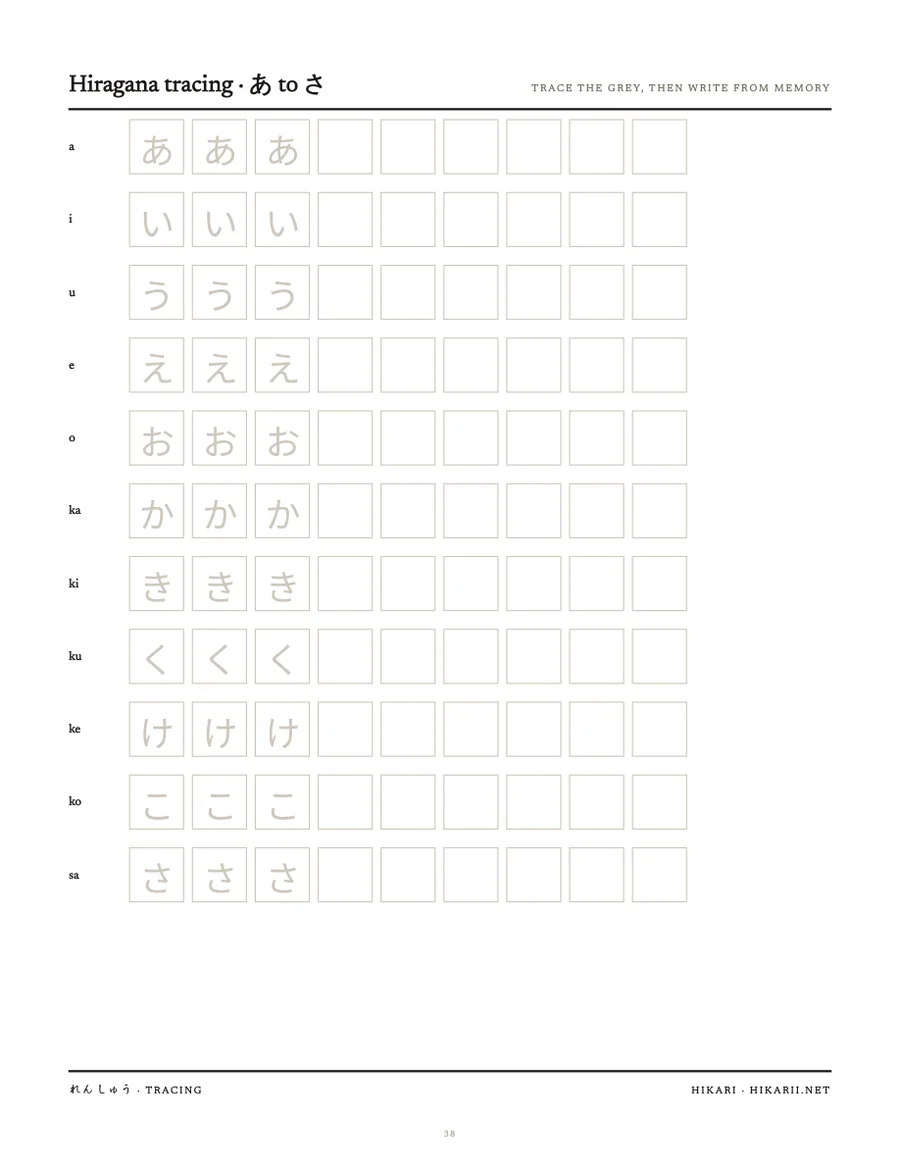
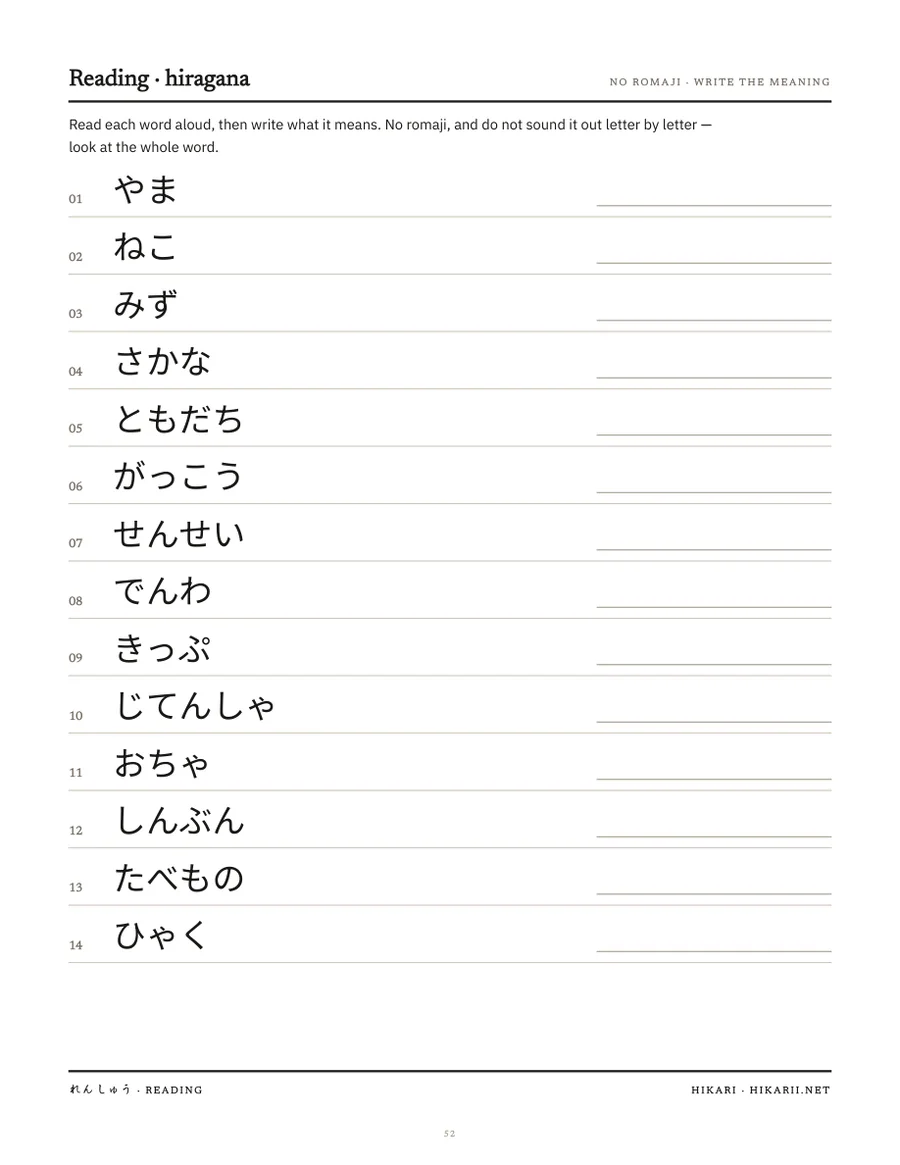
What structured hiragana practice looks like
These are real pages from the Hikari Kana Workbook. Every character gets a stroke count, a sound, a word you can picture, tracing space and a reading page where the romaji is gone.
FREE · NO COST
Start with the first fifteen, free
The Kana Starter Pack covers あ to そ: fifteen characters with pronunciation notes, real tracing pages, a mini reading quiz with answers and a progress tracker. Enough to finish your first three rows properly.
QUESTIONS
Common questions about hiragana
How many hiragana characters are there?
Forty-six basic characters. On top of those there are 25 voiced forms made by adding two small strokes or a small circle to a character you already know, and 33 contracted sounds made by adding a small ya, yu or yo. Nothing in either group is a new shape, so the real memorisation load is 46.
How long does it take to learn hiragana?
Most beginners who practise fifteen focused minutes a day can read all 46 within one to two weeks, and write them from memory in two to three. Frequency matters far more than session length: a short session every day will finish the chart, and one long weekend session will not.
Should I learn hiragana or katakana first?
Hiragana first. It carries the grammar, so nothing in Japanese can be read without it, and every katakana character maps onto a hiragana sound you will already know. Start katakana as soon as hiragana is comfortable rather than leaving it for later.
Do I need to learn stroke order?
Yes, and early. Correct stroke order makes your handwriting legible, makes fast writing possible, and is what handwriting-recognition input on a phone expects. It also makes the look-alike pairs easier to tell apart, because the difference is usually in how a stroke starts or ends.
Is it worth writing hiragana by hand if I only want to read?
Yes. Recognition and recall are different skills, and handwriting trains both. In practice, learners who only tap through app drills can recognise characters in order and lose them after a week away. Writing is the cheapest way to make recognition stick.
What is the difference between あ and お?
あ closes with a loop at the bottom right. お has a free hook and a separate short stroke floating to its right. If the shape closes on itself, it is あ.
Keep going
ONE WORKBOOK, ONE PRICE
Hikari Nihongo: Kana
All 92 characters across both scripts. Every voiced form, every combination, every look-alike pair untangled. Stroke order, tracing pages, handwriting grids, reading drills with no romaji, and a full answer key.
$9ONE-TIME · 60 PAGES · PDF
Instant downloadPrint it or use a tabletNo subscriptionYours forever
All sales are final for now: digital downloads cannot be returned after purchase.